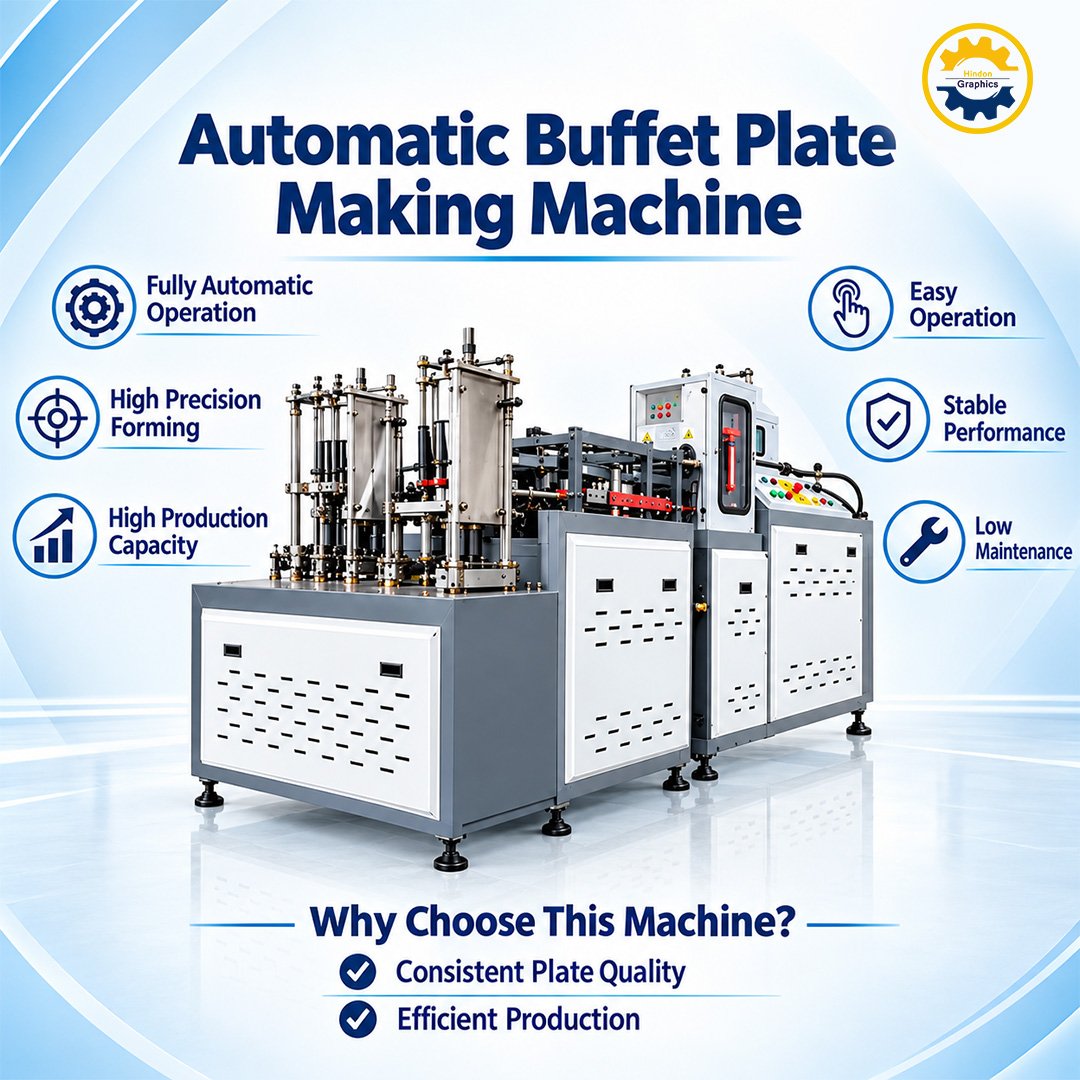
Hindon Graphics offers industrial machinery designed to support businesses involved in plate manufacturing and related disposable product applications. If you are searching for a Automatic buffet plate making machine manufacturer in Silliguri, choosing suitable equipment is an important step towards establishing an efficient and dependable production process. The right machine can help manufacturers improve production consistency, manage routine operations, and meet the requirements of their customers. Automatic Buffet plates are widely used by catering businesses, restaurants, hotels, food-service providers, event organisers, and disposable tableware distributors. Manufacturers need machinery that can produce plates with consistent shapes and a suitable finish according to the selected material, die, and machine configuration. A properly selected Automatic buffet plate making machine can help businesses organise their production workflow and reduce unnecessary manual handling. Hindon Graphics supplies machinery for industrial plate-making and sheet-forming applications. Its product range includes the HG-05 Buffet Plate Making Machine, which is listed as an automatic machine intended for industrial use. Customers can discuss their production requirements with the company to identify a suitable machine configuration. Muffin Cake Cup Machine Manufacturer in Silliguri
What Is a Automatic Buffet Plate Making Machine?
A Automatic buffet plate making machine is industrial equipment used to form plates from compatible raw materials. Depending on the machine design, the production process may involve positioning the material, applying forming pressure, shaping the plate through a die, and removing the finished product. The exact process depends on the model and the type of plate being manufactured. Buffet plates are commonly selected for serving food at parties, weddings, corporate events, outdoor gatherings, catering functions, and institutional events. Their dimensions, shape, rigidity, and finish depend on the intended application and the raw material used. Manufacturers should ensure that their machinery and tooling are compatible with their desired product specifications. For businesses planning to enter or expand within the disposable tableware market, selecting suitable equipment is an important operational decision. Production needs, available workspace, electricity supply, material compatibility, operator requirements, and maintenance arrangements should all be considered before purchasing a machine.
Key Features of Hindon Graphics Automatic Buffet Plate Making Machine
- A machine designed for industrial use should have a suitable structure and components to support its intended production workload. The machine's construction, installation requirements, and operating environment should be reviewed before commissioning.
- The HG-05 model is listed as automatic. Automation can help reduce certain repetitive manual tasks and support a more organised production process. The actual level of automation and the operator's responsibilities should be confirmed for the selected configuration.
- Suitable forming dies and correctly adjusted operating parameters are important for achieving consistent plate dimensions and shape. Regular inspection of the tooling and machine setup helps manufacturers maintain product quality.
- Stable operation supports predictable production routines. Appropriate installation, trained operators, routine cleaning, and preventive maintenance can contribute to dependable machine performance over time.
- Different plate sizes and designs may require specific dies or tooling. Before placing an order, buyers should confirm which plate shapes, dimensions, and raw materials are supported by the selected machine.
Applications of a Automatic Buffet Plate Making Machine
- A Automatic buffet plate making machine may be suitable for businesses producing disposable plates for a range of commercial applications, provided the machine is configured for the intended product.
- Catering businesses: Production of plates for catering operations and food-service requirements.
- Event supply businesses: Manufacturing plates for weddings, parties, exhibitions, and corporate functions.
- Disposable tableware manufacturers: Production of compatible disposable plates for wholesale distribution.
- Food-service product suppliers: Supplying plate products to restaurants, caterers, and institutional buyers.
- Wholesale distributors: Sourcing manufactured plates for retail and commercial customers.
Benefits of Choosing Suitable Plate-Making Equipment
- Appropriate machinery helps organise the plate-forming process. When the equipment, material supply, and finished-product handling arrangements are planned together, operators can follow a more systematic workflow.
- Correct tooling, suitable raw materials, and regular process checks help maintain consistency in plate shape and dimensions. Manufacturers should establish quality checks appropriate to their products and customer requirements.
- Understanding the machine's actual production capacity helps businesses estimate output, plan raw material purchases, schedule operators, and manage customer orders. Always use the manufacturer's confirmed capacity for the chosen model when preparing production calculations.
- Depending on the machine's automation level, certain repetitive tasks may be simplified. This can help operators focus on monitoring the production process, inspecting finished plates, and maintaining a clean work area.
- Businesses experiencing increased demand may evaluate additional machinery, tooling options, or improvements to their existing production process. The choice should be based on real demand, available space, operating costs, and expected output.
How to Choose the Right Automatic Buffet Plate Making Machine
- Selecting machinery requires more than comparing the initial purchase price. Buyers should evaluate the complete production requirement and ensure that the equipment matches their intended product range.
Plate size and design: Identify the plate dimensions, shape, depth, and finish required by your customers. Confirm whether the machine and its available dies can produce those designs.
Raw material compatibility: Discuss the exact material and thickness or grammage you plan to use. Do not assume that every plate-making machine can process all paper, laminated sheets, or other materials.
Production capacity: Estimate your expected daily and monthly demand. Ask the manufacturer for the confirmed output under specified operating conditions and material settings.
Automation requirements: Determine which operations are automatic and which require manual intervention. Understand the staffing and operator training required.
Power supply: Confirm the rated voltage, phase, frequency, connected load, and electrical installation requirements before installation.
Maintenance and spare parts: Ask about recommended maintenance intervals, commonly replaced parts, tooling care, and the availability of technical support.
Installation and training: Confirm what is included in installation, commissioning, operator training, and after-sales assistance.