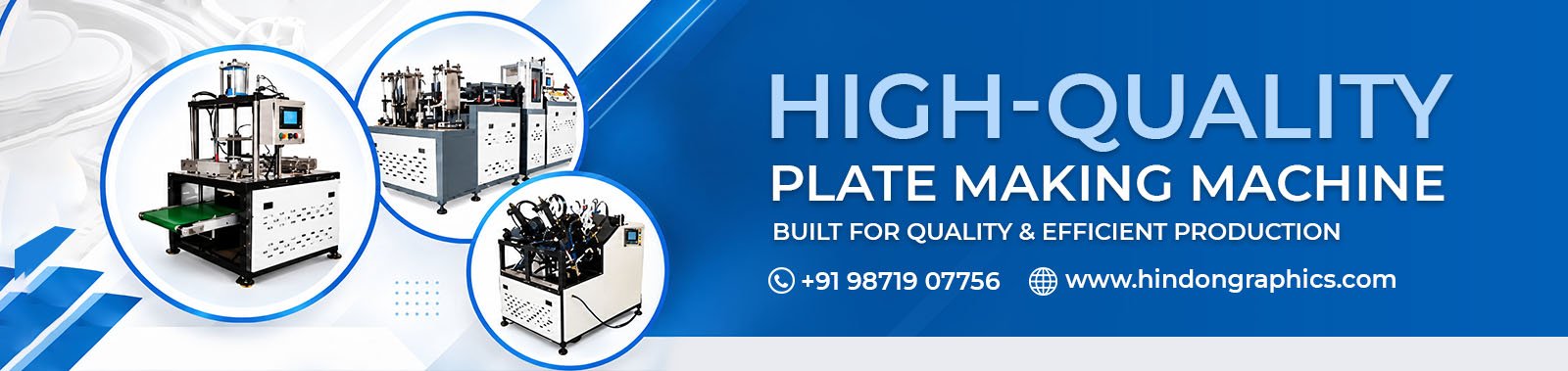
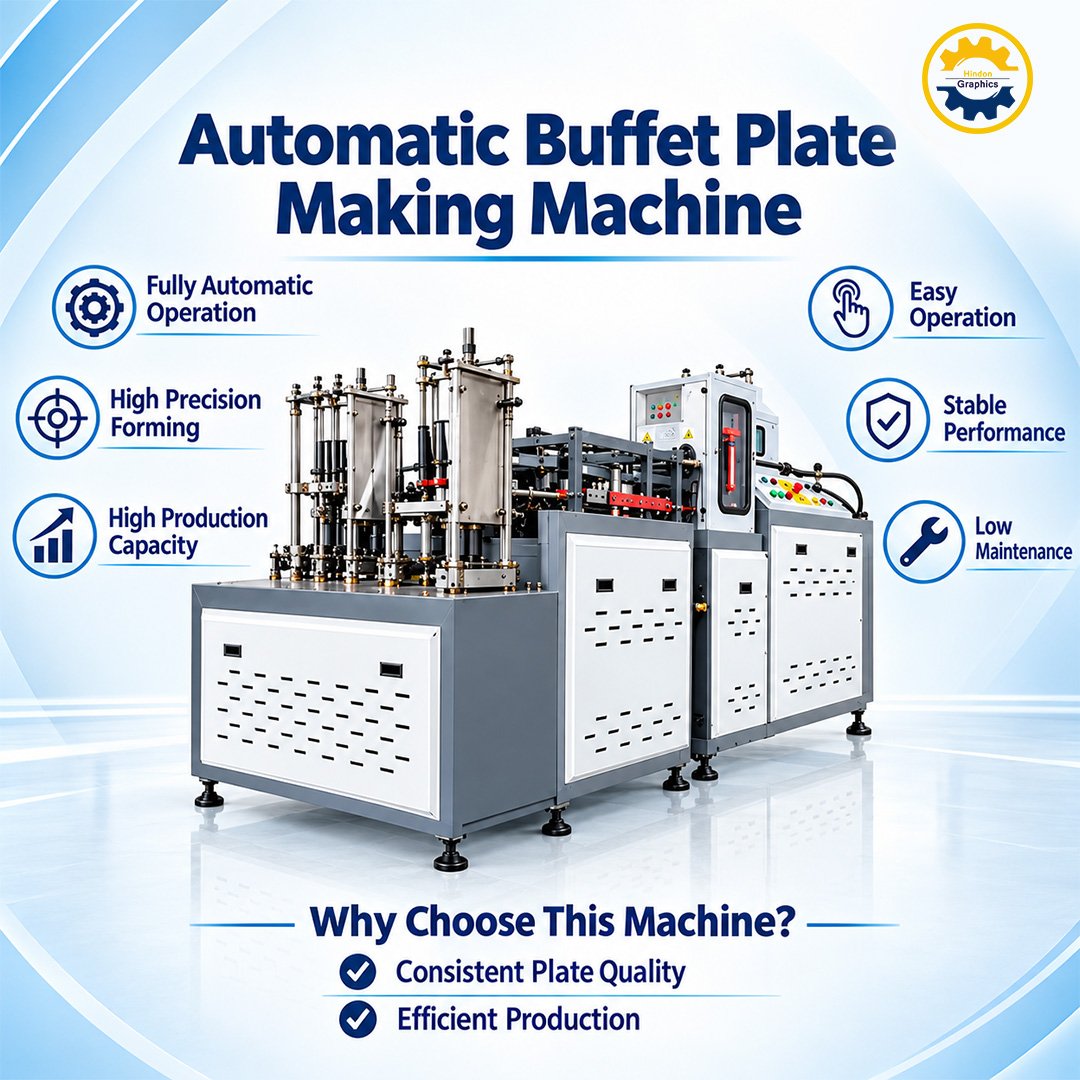
Hindon Graphics offers industrial machinery for businesses involved in disposable tableware manufacturing, plate forming, cutting, and related production applications. Companies searching for an industrial sheet forming buffer plate machine in Silliguri should consider equipment that matches their required product design, raw material, production volume, and operating conditions. Sheet-forming machinery helps transform compatible sheet materials into specific shapes using a forming mechanism and suitable tooling. In plate manufacturing, the choice of machine depends on the material being processed, the desired plate dimensions, the forming method, and the level of automation required. Selecting appropriate equipment can help manufacturers establish a structured production workflow and manage repeat orders more efficiently. Hindon Graphics lists the Industrial Sheet Forming Buffer Plate Machine among its product offerings. Buyers should contact the company to confirm the exact machine configuration, intended applications, supported materials, and available tooling before placing an order. Buffet Plate Making Machine Manufacturer in Silliguri
What Is an Industrial Sheet Forming Buffer Plate Machine?
An industrial sheet forming buffer plate machine is equipment intended for forming compatible sheet material into a required plate shape or related product, depending on the machine design. The forming process may involve positioning a sheet, applying mechanical pressure or another forming action, shaping the material through a die, and removing the formed product. The specific meaning of “buffer plate” can vary by manufacturer and application. Buyers should therefore confirm the product type and intended use with the supplier rather than assuming that every buffer plate machine processes the same material or produces the same type of plate. For manufacturing businesses, choosing the correct machine starts with defining the finished product. Important considerations include plate dimensions, material thickness, shape, edge finish, expected production quantity, and compatibility with the forming mechanism. A clear specification helps the manufacturer identify an appropriate machine configuration.
Importance of Sheet Forming in Industrial Production
- Sheet forming is used in manufacturing processes where a flat or semi-finished material needs to be shaped into a particular design. The suitable forming process depends on the material's properties, the geometry of the finished product, and the production requirements.
- In plate manufacturing, accurate tooling and appropriate machine settings are important for maintaining product shape and consistency. A suitable forming setup can also help organise the flow of material through the production area, making it easier for operators to handle raw sheets, inspect finished products, and prepare orders for further processing.
- Businesses should evaluate the entire workflow rather than looking only at the forming machine. Material storage, feeding, finished-product collection, inspection, and packing all affect overall production efficiency.
1. Industrial Machine Construction
- Industrial machinery should be designed for its intended operating environment and production workload. Buyers should review the machine's construction, installation requirements, accessibility for maintenance, and suitability for their factory layout.
- 2. Sheet Forming Capability
- The machine's forming capability should match the material and finished-product design. Ask the manufacturer which materials, thicknesses, plate shapes, and dimensions are supported by the selected configuration.
- 3. Die and Tooling Compatibility
- Tooling has a direct influence on the shape and dimensions of the formed product. Before purchasing, confirm which dies are included, which additional designs are supported, and whether changing tooling requires special adjustments or downtime.
- A suitable machine should fit the planned workflow, including material loading, forming, product removal, inspection, and collection. Consider the amount of manual handling required at each stage.
Applications of Industrial Sheet Forming Machinery
- The applications of a sheet-forming buffer plate machine depend on its verified design and material compatibility. Potential applications should be confirmed with the manufacturer before the equipment is selected for a specific production process.
- Where the machine is designed for plate forming, it may be used to shape compatible sheet materials into specified plate designs. The supported plate sizes and materials depend on the forming system and available dies.
- Manufacturers of disposable tableware may use specialised forming machinery as part of their production setup. Buyers should confirm whether the machine is specifically intended for paper plates, coated sheets, or another material before considering it for this application.
- Some sheet-forming equipment is designed to create specific shapes from suitable industrial materials. The type of material and finished component must fall within the machine's technical capabilities.
- Businesses that manufacture products for other companies may require machinery capable of producing consistent parts to an agreed specification. The machine should be evaluated against the customer's design, material, quality requirements, and production schedule.
How to Choose the Right Industrial Sheet Forming Machine
- 1. Define the finished product. Prepare the product dimensions, shape, material, thickness, and any drawings or samples. Explain the intended application to the supplier.
- 2. Confirm the material range. Identify the exact sheet material and any coating or surface treatment. Obtain confirmation that the machine can process it under the intended operating conditions.
- 3. Check the forming method. Ask how the machine forms the material and whether its mechanism is suitable for your product design.
- 4. Verify production capacity. Request the rated output for your specific product and clarify the conditions under which that output is achieved.
- 5. Review tooling requirements. Confirm the number and type of dies included, the availability of alternative tooling, and the cost of future changes.
- 6. Check the electrical supply. Obtain the machine's rated voltage, phase, frequency, connected load, and other installation requirements from the supplier.
- 7. Evaluate operator requirements. Understand the level of automation, manual handling tasks, training needs, and safety procedures.
- 8. Calculate operating costs. Consider raw materials, electricity, labour, maintenance, tooling, packaging, and quality-control costs when evaluating the total investment.
- 9. Ask about installation and support. Confirm delivery, commissioning, training, warranty conditions, spare parts, and service arrangements in writing.
- Quality Control and Material Selection
- The finished product's quality depends on the raw material, tooling, forming process, and operating settings. Manufacturers should use material that meets the machine's requirements and establish quality checks appropriate to the intended product. Inspection may include verifying dimensions, shape, edge quality, surface condition, and visible defects. Where the finished product has specific customer or regulatory requirements, these should be included in the quality-control process. Material should be stored in a suitable environment to prevent contamination, moisture-related problems, deformation, or damage. Operators should follow the manufacturer's handling and setup instructions to reduce avoidable material waste. For products intended for food contact, verify that the raw material and finished product meet applicable food-contact requirements. Do not assume food-contact suitability without supporting material documentation.
Before installing the machine, prepare sufficient floor space for the equipment, raw material, finished products, operator movement, and maintenance access. Electrical installation should follow the manufacturer's instructions and be completed by a qualified professional. Operators should receive appropriate training before using the machine. Training should cover start-up, shutdown, routine operation, safe material handling, emergency procedures, and the precautions associated with moving or heated components where applicable. Maintenance should follow the machine-specific manual. Depending on the design, routine tasks may include cleaning, inspecting dies, checking accessible components, and arranging scheduled servicing. Repairs and adjustments should be carried out by suitably trained personnel with the machine safely isolated. Keeping maintenance records helps the business monitor servicing, recurring issues, replacement parts, and production interruptions. A preventive maintenance plan can support more dependable production scheduling.